
UCLA, Los Angeles, September 19, 2026. Saturday, the final day of the symposium at UCLA, was highlighted by the AHCT awards and by the Donald T. Dietz Plenary Lecture, delivered by Barbara Fuchs, director of Diversifying the Classics at UCLA.
The Vern Williamsen Comedia Book Prize went to Mary B. Quinn for Sense and Spectacle in the Age of Felipe IV (Amsterdam University Press, 2024). Across a strong field of nominees, the judges singled out the book for its sustained attention to performance and spectacle, and for showing how the aurality of empire shaped Golden Age theatrical culture under Philip IV. Its later chapters carry that inquiry to Italian opera and colonial celebration, broadening our understanding of how spectacle functioned across the early modern Hispanic world.
The Amy Williamsen Collaborative Research Prize was awarded to Kerry K. Wilks and Ian M. Borden for The Entremés for Performance: Translations of One-Act Plays from Golden Age Spain (Liverpool University Press, 2024). The volume gathers short plays by dramatists ranging from Juan del Encina and Cervantes to Calderón and the lesser-known Mariana Cabañas. These translations are written directly for the stage, attentive to the sound, pacing, and comic business that make the plays work before an audience. With its adaptations for a modern company and its pedagogical appendix, the book is a genuine collaboration that reaches from scholarship into the rehearsal room.
The Donald Dietz Comedia Prize in Service to the AHCT honored Susan Paun de García for her many years of dedication to the association, including a long tenure as president. Her leadership and professionalism were decisive during years of great change, and the relationships she fostered continue to serve the AHCT’s mission. Finally, Kailey Henderson of Michigan State University received this year’s Hesse Grant, which recognizes outstanding work by a graduate student. Congratulations to all!
In her plenary lecture, “Cutting-Edge Comedia,” Fuchs argued that the comedia is no museum piece but a form that participates fully in whatever the theater is experimenting with at any given moment. She traced that idea through Diversifying the Classics’ long partnership with Grumelot, the innovative Madrid company that has been invited several times to LA Escena and whose work includes, for example, a Lope told with household objects on a tabletop, and through the new comedia-based works the project has commissioned in Mexico City and Buenos Aires. She also announced LUCES, a new performance-as-research network, and her co-editorship of the Bulletin of the Comediantes with Margaret Boyle.
As for the papers, the day opened with the Radio Comedia roundtable, moderated by Laura Muñoz, in which Marta Albalá Pelegrín, Rebecca Smith, and Katerina Levinson shared Diversifying the Classics’ work turning comedias into audio drama and podcasts, all of it freely available for the classroom. In the parallel session, Harley Erdman spoke on the converso banquets of La reina Ester and La prudente Abigail, both translated in his new Converso Plays of Seventeenth-Century Spain (Aris & Phillips Hispanic Classics). On the same panel, Marissa Luquette explored voice and race in María Antonia de Blancas, and Habib Zanzana examined the child as witness in Cervantes.
The afternoon began with a session on secular concerns explored through religious pretexts. Morgan Schneider of the University of Tennessee, Knoxville, argued that the devil in El mágico prodigioso, Las cadenas del demonio, and El condenado por desconfiado works less as a simple antagonist than as a moral test. Francisco Javier López Martín of Denison University followed the idea of the theatrum mundi from Calderón’s El gran teatro del mundo through Shakespeare to the German Trauerspiel, where the modern subject is left performing on a stage whose Author no longer answers. Carmen Saen de Casas of Lehman College showed how Antonio Enríquez Gómez, living in hiding in Seville under the name Fernando de Zárate, turns the Visigothic princess Ingunda in San Hermenegildo into the regina fortis of the funeral sermons for Habsburg queens.
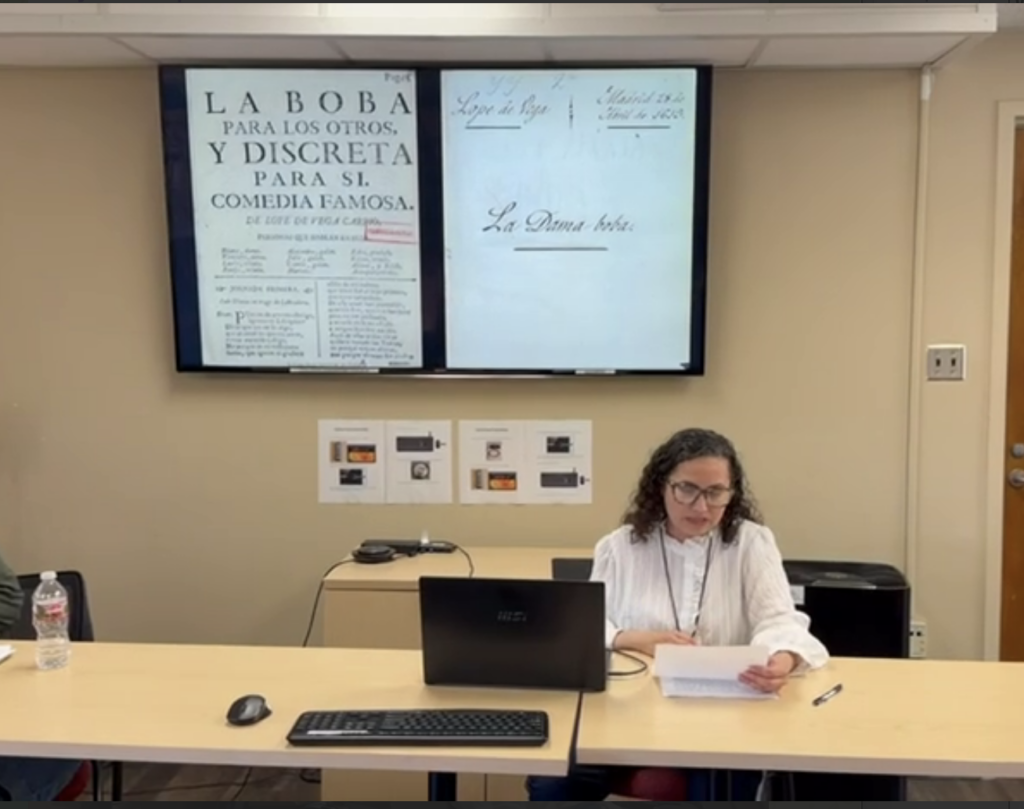
A second afternoon panel, moderated by Bruce Burningham, focused on spaces of conflict. Gissaeli Cruz offered an ecocritical reading of Lope’s El Nuevo Mundo descubierto por Cristóbal Colón, and Alani Hicks-Bartlett examined feigned melancholy in El príncipe melancólico. Judith G. Caballero Navarro closed the panel with feigned foolishness in La boba para otros y discreta para sí and La dama boba.
LA Escena brought the day to a close with Donde comen dos, comen tres, a staged reading of a free English-language version of Lope’s El perro del hortelano set in 1940s Los Angeles; an illuminated lecture on La Celestina by Barbara Fuchs, with performances by the actors of theatre dybbuk; and, to end the night, Canciones de Olmedo, a musical adaptation of Lope de Vega’s El caballero de Olmedo by the company Jóvenes Clásicos.
A final reminder: revised papers for Comedia Performance are due by mid-August 2027. Ahead of us are an online conference in June 2027, Tallahassee in February 2028, and our return to Los Angeles in September 2028. Until then!

