
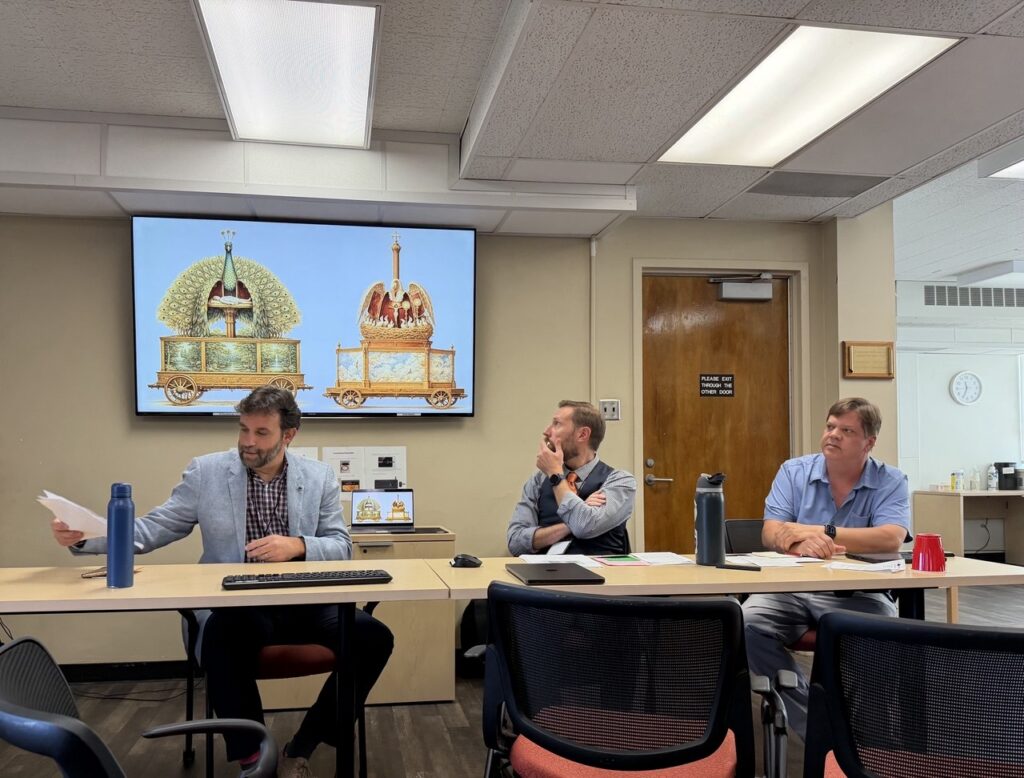
UCLA, Los Angeles, September 18, 2026. The second day offered a wide range of high-quality presentations. Scholars, artists, and arts managers shared ideas and projects to grow the practice of Golden Age theater and its audiences.
The LA Escena Festival artists’ panel, moderated by Laura Muñoz, brought together Christian Nájera, Paola Izquierdo, and José Carlos Cuevas. They talked about staging the classics far from the major theater centers, where scarce resources sharpen ingenuity and give rise to cabaret, sitcom, or audio fiction. In a parallel session, Valerie Hegstrom read Lope’s La vengadora de las mujeres alongside Christine de Pizan and the recent production by the CNTC. Kailey Henderson, recipient of the 2026 Hesse Award granted by the AHCT, reflected with self-critical rigor on her dramaturgy for Valor, agravio y mujer from the perspective of trans studies. Gabriela Villanueva Noriega presented the New Dramaturgies Lab Residency (Residencia-Laboratorio Nuevas Dramaturgias) of UNAM and UCLA, the origin of La casa de empeños, which premiered tonight at the festival. The discussion ended with a concrete proposal: to gather Spanish-language outreach materials on the AHCT website.
Next, DeLys Ostlund compared the adaptations of La prueba de los ingenios by Caridad Svich and Noelia Pérez. The Translation Lab (Kerry Wilks, Ben Gunter, Kathleen Costales, and Anthony J. Grubbs) presented its English translation of Calderón’s Amigo, amante y leal, the first comedia documented by title in Florida, performed in St. Augustine in 1789 to celebrate the coronation of Charles IV. In the adjoining room, the chivalric comedia took center stage. Harrison Meadows read Las mocedades de Bernardo del Carpio as a reworking of La mocedad de Roldán. Christopher Oechler showed a Christ who aspires to the habit of a military order in Calderón’s Las órdenes militares. Drawing on promptbooks held at the Biblioteca Histórica Municipal de Madrid, Alexander McNair reconstructed the belated return of Las mocedades del Cid to the Madrid stage in 1813.
Lunch took place at UCLA with all the speakers in attendance, at a social gathering that welcomed the association’s new members. It was a lively meal during which, without a doubt, many new projects on the comedia were born.
Adrián Pérez Boluda analyzed the mythological eroticism of El amor enamorado. Robert L. Turner presented a scaffolded model for using artificial intelligence in the advanced classroom, tested with the opening verses of Marta la piadosa. The tool guides students from the vocabulary and syntax of verse to interpretation and the formulation of a thesis, and its support is withdrawn as students gain independence. The proposal sparked one of the day’s liveliest discussions on how to bring difficult texts to new generations of readers. Rob Bayliss proposed approaching the comedia through heritage studies. Using the concept of authorized heritage discourse, he examined how institutions such as the Almagro Festival, the CNTC, and the Instituto Cervantes produce and consecrate the comedia as cultural heritage, and how it is experienced differently on each side of the Atlantic.
In a parallel session, John Slater transported the room to the Golden Age town square: a motley space where acrobats, tightrope walkers, charlatans, and theriac sellers competed with preachers and actors for the attention of the same public. With vivid examples such as the juggler tossing a glass flask or the theriac seller who lets a snake bite him to prove his antidote, he showed how preachers not only condemned this world of spectacle but also sacralized it and turned it into an image of Christian life. Ana Yunuén Castillo Colín presented her production of Lope’s El hijo pródigo for the Museo del Prado, built on Murillo, Baroque gestural codes, and accents from across the Hispanic world.
The final block focused on the body and on Sor Juana. J. Yuri Porras traced the music of the Chamizal Siglo de Oro Festival from 1985 to 2013, from the first uses of recorded music to the period instruments of Nao d’amores. This research is part of the Comedia Performance special issue on the festival’s legacy, edited by Alejandra Juno Rodríguez Villar and Esther Fernández in two numbers: the first published in 2026, and the second forthcoming in 2027. Both pay tribute to the Chamizal, the dean of classical theater festivals and, sadly, defunct since 2020, which for decades served as a stage laboratory and a meeting point for comedia studies in the United States. Bruce Burningham documented Honra, Elisa Sanz’s unrepeatable piece at Almagro. Elizabeth Cruz Petersen presented Moving Muses, a project that restores a sculptural and theatrical body to four seventeenth-century autoras de compañía, women who led theater companies. In the other room, Mayra A. Cortes listened to the Loa for El divino Narciso as acoustic transculturation. Beatriz Salamanca read Los empeños de una casa through the law of hospitality, and Paula Rodríguez presented the BADA program that in 2027 will bring together Sor Juana and Lorca between London and Andalusia.
The evening opened at LA Escena with La casa de empeños, a version of Sor Juana Inés de la Cruz’s Los empeños de una casa written and directed by Christian Nájera. The production is a Baroque sitcom that moves through metatheater. Nájera used the intermissions to tell, in an autobiographical key, how the show came to be, so that the audience watched both the version of Sor Juana’s comedia and the story of its adaptation.
The night closed with Amar después de la muerte, a musical radio-play version of Calderón’s work by Jóvenes Clásicos, with music by Nacho Doña. Audience members watched the actors read their lines in character and discovered how radio sound effects are created live. The musicians, also on stage, performed the musical numbers incorporated into the text and provided the musical underscoring for the entire show.
Tomorrow, Saturday, September 19, the third and final day of the symposium will feature the AHCT awards ceremony and the plenary lecture by Barbara Fuchs.

